Tag: BookRecommendations

  • Great Books Roundup of 2021

    A bit overdue, but here we are. 2021 has definitely ended. Probably. If you perchance wish to bury your face in a book (which would be weird, considering how great the world is right now), hopefully you can find some here that pique your interest — or that you might now know to avoid. I also left in more books that I would have left off in past years, which is to say hope you’re a fan of romance novels too. Or just skip over those. If you’re a coward. The list order is roughly the order in which I read them, which is of precisely no help to anyone, so have fun!

    Side note, my notes don’t really bother with actually, uh, summarizing the books or anything. That’s what publishers are for (especially since they aren’t even doing their own promos for their books anymore?? But that’s another issue for another time).

    Blood Heir by Ilona Andrews

    This is the first in their spin-off series from the Kate Daniels series and, look. I will read anything that they write, and they write a lot. Some of their books are a little weaker, especially earlier in their oeuvre. This book? I need more. This is my kind of book. Well-established world, fantasy, weirdly strong people, magic, humor, hidden identities, dramatic irony, it’s got it all. 10/10 recommend… starting with the Kate Daniels series though.

    Quiet by Susan Cain

    Ok this was published in 2012, and Mom remembers it being revolutionary at that time. For me, reading it in 2021, a lot of it seemed just kind of… obvious. And this is honestly in its favor: it had a significant influence on the public discourse. “The book that started the quiet revolution.” Of course not everyone is outgoing and gregarious naturally — and throughout history, there have been periods of time where that has not been the assumed default as it is now. A lot of the default/assumed extroversion that Cain talks about is still very much present in society today, but based on her writing I would hazard a guess that it is no longer pathologically bizarre to be an introvert as it seems to have been (to her?). And still, her insights are useful, and combined with her engaging writing, this makes for a good read. She also has a knack for highlighting systemic absurdities that come with the Extrovert Ideal. Introvert power!

    Begin Again by Eddie S. Glaude Jr.

    Racial commentary through the lens of James Baldwin’s writings and life. It’s not exactly a biography, more of an homage and continuation/lit crit. In the main, it discusses and breaks down “The Lie” that underpins our society: that the white man is the superior being, using both events from Baldwin’s life and current events. Glaude hones in on the issues with unflinching clarity and diagnoses ruthlessly. The kid gloves that white Americans are accustomed to are off, and rightly so. The anger that Glaude diagnoses in Baldwin also appears in his own writing. I found that it drags slightly in the middle, but then it picks back up and roars to a deeply compelling close. Very much recommend.

    Veronica Speedwell series by Deanna Raybourn

    A series of mystery novels set in Victorian England, following the adventures of the (young and attractive, of course) lepidopterist Veronica Speedwell.

    A Curious Beginning

    The writing was a little clunky, and the mystery relies on characters withholding info. Still, very fun and good characters — hard to put down (in fact I did not, as I read it in one sitting).

    A Perilous Undertaking

    Again, a mystery that relies on withheld information, but I guess that’s most mysteries? So not an actual critique? Maybe? We meet some good new characters, and overall the book is character-driven (good).

    A Treacherous Curse

    Finally just suspects not showing their hand instead of friends withholding information! Modern (anachronistic?) view of Victorian Egyptology, unusual but nice enough. Story engaging, not the best but good.

    A Dangerous Collaboration

    Bringing the story back home, vaulting the love story forward. [Note from the time of posting this: I don’t know what I meant by “bringing the story back home.” I think this book is the one that explores the main character Veronica Speedwell’s backstory?] Plot was more focused on characters than on the mystery, but great setting too.

    A Murderous Relation

    Brings the plot back home to Veronica and her family. [Ok maybe I was mistaken with my last editor’s note? Man I should really take better notes. But I won’t.] Much adventure, from a sex club to many murders (and we finally get an implied brush with Jack the Ripper, which, can you even have a Victorian murder mystery without him making a cameo?) and finally love triumphs. They really took their time, eh?

    An Unexpected Peril

    This is, I believe, the latest currently published. Shenanigans + bury your gays + Roman Holiday in reverse. Not the best of the series but still good. [View from the editor’s couch: I’m pretty sure I remember more from this book than from any of the others, for what that’s worth, and I remember really enjoying most of it.]

    Through the Storm by Beverly Jenkins

    While this is ostensibly (and definitely actually, don’t get me wrong) a romance novel, but it has lots of end-of-the-Civil War history packed in. Loved the characters, and the plot felt just right for the setting.

    The Lady’s Guide to Celestial Mechanics by Olivia Waite

    Delightful Regency romance, complete with aspiring women academics getting maddeningly shut out by loutish men. Definitely a feel good (in spite of that).

    Gideon the Ninth by Tamsyn Muir

    THIS IS EVERYTHING I HAVE EVER WANTED. Space necromancers (which I didn’t know I wanted, but I do now). Portal 2 fever dreams. Hot sword ladies. Much humor. A lot of characters to keep track of, but the author does provide a handy guide (handier if you have a physical copy, maybe [which I, uh, now do]). Well written and a good plot, as long as you trust things to be eventually explained. Recommend.

    Harrow the Ninth by Tamsyn Muir

    NO I LIED THIS IS EVERYTHING I EVER WANTED. Hoooo boy. Vanishingly rare use of 2nd person narrative to devastatingly good effect. Slower read than book 1 owing to tangled narratives (and brains), and a lot of complex motives to follow. Excellent. (Bonus points awarded for the tactical use of the phrase “sacrificial parsnip.”)

    A Libertarian Walks Into A Bear by Matthew Hongoltz-Hetling

    The story of Grafton, NH’s libertarian “Free Town” experiment and its corresponding bear problem. MHH takes a deep dive into the history of the town and into the actors involved — including some very unexpected ones. Libertarians probably aren’t thrilled with their depiction (oh nooo), but the result is an entertaining, if rather long and convoluted, tale of peoples’ relationships to each other and the world. Maybe grab the Blinkest copy. (Is Blinkest still a thing?)

    The Care and Feeding of Waspish Widows by Olivia Waite

    I wanted to like this more, but the feel-good parts were frequently drowned out by stuffing in all of the social injustices of the time: anti-gay + Six Acts + women as property + class inequality is a bit much for one romance to overcome, and this isn’t one of the stronger romances.

    The Witches Are Coming by Lindy West

    Collection of sharp, smart, funny essays on racism, feminism, and the future of this country and the world. The theme throughout — the Witches are coming — grounds the ideology in the rising tide of the oppressed against those who have long held the reins of power. Overall very good.

    Untamed by Glennon Doyle

    Mostly good, some excellent points but also some highly questionable ones that get a little, hmm, girlbossy. Fairly quick read, especially through the bite-sized chapters. Overall recommend, but not glowing.

    Archer’s Goon by Diana Wynne Jones

    Catching the few novels of hers that I missed growing up. This is classically delightful DWJ: vivid characters, plenty of confusion, and magic that is both never explained and completely intuitive. Loved it.

    Witch’s Business by Diana Wynne Jones

    This is her first published children’s novel — fun, strong characters, good plot if a little messy.

    Wintering by Katharine May

    Loved this. Some of the “wintering” ideas seemed a little forced, but that’s my main quibble with an otherwise very thoughtful and beautiful read. The last third-ish was a little less engrossing to me, but still excellent. Highly recommend.

    The Vanishing Half by Brit Bennet

    Beautifully written once it gets going. Many emotionally poignant moments, good introspection, and strong characters. It’s in roughly chronological order, dates included, but I struggled a bit to remember them (that’s a me problem). Weakest imo was Kennedy’s later storyline.

    Chlorine Sky by Mahogany L. Browne

    Novel in verse (!) about a Black girl finding herself in an unfriendly world, and also school. Quick read and engaging. Excellent ending. Recommend.

    Shadow and Bone by Leigh Bardugo

    So I watched the Netflix show based on this book, and I liked it enough to read the book. The book has a decent story, but I have to say it’s not very well written. To be a cliche of every editor ever, it’s very tell instead of show, and I never felt like I really understood any of the characters. The TV show was better and more intriguing.

    Seige and Storm by Leigh Bardugo

    First novels are hard, I get it. Unfortunately, I feel like I deserve a medal for finishing the second installment. Seriously, nothing happened for 70% of the book, except like casual horrific Frankenstein experiments and more telling without showing. Also needed some editing love, because scenes were ROUGH.

    Ruin and Rising by Leigh Bardugo

    Ok at least things happened in this book, even if the author clearly needs to try standing in a “rushing” river that is CHEST HIGH?? EXCUSE ME?? NO. Ending was acceptably satisfying, although by saying that I am also forced to say that I am very against honoring mass murderers* (?!). The style of starting and ending each book in the trilogy with the “boy and girl” narration was… fine. I guess. It didn’t really do anything for me. Would not reread. I want that time back.

    *I am very pro redemption arcs, but the have to be full arcs. There are elements that have to be present for them to work, crucially: the character has to want redemption. Wanting redemption means that they know they done goofed, they acknowledge that, and they know they need to take steps to try to atone. There was no redemption arc that I could detect in this trilogy. Ergo, it’s just honoring a mass murderer. Which is bad.

    The Invisible Life of Addie LaRue by V. E. Schwab

    Great premise. Honestly really solid until the end: I just wasn’t quite sold by the very last chapter.

    Six of Crows by Leigh Bardugo

    Big improvement on the previous series. Sharp plot, fun characters, good heist. Really enjoyed.

    Crooked Kingdom by Leigh Bardugo

    Unfortunately, this was weaker than book one: more convoluted, and not to its benefit. Still entertaining, but it just kept going and getting bigger and higher stakes and also worse while also pulling inward and becoming more personal? Idk how to describe what happened, and I kind of think neither did the author.

    Circe by Madeline Miller

    Honestly I spent the whole book both intrigued and also not really caring about any of the characters, so that’s pretty impressive I guess. Really wasn’t terrible. I guess.

    We Were Never Here by Andrea Bartz

    I got queer baited by this book, and I’m pretty sure I have only myself to blame. But honestly, the version that was happening in my head was much more interesting than what was in retrospect really going on. It started pretty strong (in my head at least), then the last third was just a downward slide. The end was aggressively meh bordering on actively bad. Should’ve let me rewrite it.
  • Emory’s Awesome Books of 2020

    Emory’s Awesome Books of 2020

    Well, it’s been a year. As a deeply dedicated introvert, the part where we couldn’t leave our houses wasn’t much of an issue for me, especially once there was no work pour moi and I had no reason to ever leave my comfy chair. On the other hand, existential threats aren’t great for the old brain box, so I did a lot of rereading comfort books when I was able to settle down to read. I also listened to a lot of podcasts during the (many) times that I couldn’t settle down to read. But I managed to read some new books in 2020, and I’ve picked out my favorites to highlight. I think it’s almost as cool as Obama’s book list, which means that I’m almost as cool as Obama!

    In any case, I consumed some media this year. Mostly good. Strangely, even though Capitalism™ doesn’t much care about The Arts, human beings still like it and continue to produce and consume it. Here are some of my favorites from the new (to me) books that I read this year! Order is based simply on the order in which I read things, not at all in order of recommendation. (Some of these I have indeed already written about, in case you start getting that deja vu feeling.)

    Nonfiction Books of 2020

    Bird By Bird — Anne Lamott

    Ostensibly a book on writing, this is also full of life advice that’s good for anyone. Advice on the process and realities of writing are easily applicable to other life aspects; highly recommend. She do be a little religious, so if you’re allergic to that — I still recommend, but I’ll give you this heads up.

    Range — David Epstein

    This one is a critical examination of the modern love of specialization, and why that is stifling innovation. It also delves into why you shouldn’t feel left behind if other people are ahead of you in your chosen field: different paths give different specialties and collections of knowledge, which may in the end give you the advantage. The core of his argument is BREADTH vs DEPTH. The latter is valuable, but without the former, true progress becomes very difficult. Connections are the true strength that humans have. Engaging anecdotes and strong parallel conclusions weave a compelling narrative.

    Invisible Women — Caroline Criado Perez

    Data bias in a world designed for men. In 16 chapters, Perez systematically breaks down all aspects of life in which women are at a statistical disadvantage. And, it turns out, that’s nearly all of them. More, this is driven by a lack of data on women, because — as she reiterates time and again — men are the default, and women are the abberation. MUST READ.

    Talking to Strangers — Malcolm Gladwell

    A deep dive into how we misinterpret interactions with people we don’t know, using some rough real life examples and breaking down what went wrong. It shows how our assumptions are frequently wrong, and how we have to be careful with strangers and assumptions. Also alcohol bad. Audiobook recommended for the musical element (strangely a podcaster makes a good audiobook?).

    The Library Book — Susan Orlean

    This is a love letter to libraries, written through the lens of a journalist’s search for the truth behind the Great Library Fire of 1986, which destroyed part of the LA Central Library and its collection. She weaves together the current state of libraries and the history of the LA system. In the end, her search for the culprit who was rumored to have set the fire basically takes a back seat to the story of the library itself. If you like libraries at all, this will be a great read for you!

     The Education of an Idealist — Samantha Power

    This is Power’s autobiography, starting from her childhood in Ireland and then Pittsburgh, her years as a foreign correspondent during the Bosnian War, and through her service in the Obama administration as Ambassador to the UN. It has a very personal feel, and her life makes for an engaging story. At the heart, this tells her story of living life while being adjacent to Big Events. Bittersweet to read about the struggles of the Obama administration trying to manage situations like Ebola and Syria. In closing: US’ biggest asset is its people, and at the end of the day it’s only about family. If you like autobiographies, this one actually feels deeply personal and intimate, and I highly recommend it.

    How To Do Nothing — Jenny Odell

    In this book, Odell builds the case for “resisting the attention economy” using a combination of her own experiences and expert accounts. Her thesis revolves around getting back in touch with the Earth, and all the good that derives from that — especially the slower pace and deeper connections that are demonstrably healthier for our brains. She examines historical sways towards this, from Epicurus to the commune movement of the 1960s, detailing the successes and failures. (Notably she at one point outlines Peter Thiel’s capitalist dream and proceeds to hilariously nuke it from existence using quotes from Hannah Arendt.) This also outlines the impossibility of removing oneself from society. One has to participate, by the fact that we are all human and must at some point interact with other humans; therefore, what’s left is simply to decide how one will participate.

    More details (not neatly presented) because I have so many notes from this book:

    Capitalist society is built as person–against–person struggle, which leaves little room to struggle against the greater systemic problems — such as attention. Corporate retreat-style unplugging fails to address the root problems, instead reinforcing the idea that wE mUsT bE pRoDuCtiVe. Those who can escape the established system need to make space for those further down the line (create MARGINS). Art helps us to question assumptions. Not knowing everything about yourself is reason to keep living. This goes against advertising to be yourself, which is assumed therein to be some pre-defined static object.

    Humans are — and cannot be separate from — the natural world. And why do we privilege sentience? Isn’t that just a way of further privileging humanity as the best? Diversity is strength, as is a sense of community. (She makes the beautiful comparison of homogenous neighborhood = single crop farm). The proposed next era is the Cthulucene: an earth full of refugees without refuge. All fates are linked, so we must find balance rather than control, and examine destruction vs “construction”.

    Back to the attention economy: we need context to our communications, which social media does not provide. This leads to lack of attention and knee-jerk reactions that can be easily exploited. Social media also collapses content into a “lowest common denominator,” for all audiences at once. That means there is no nuance between social groups. The attention economy is designed to trap you in fear.

    The Deficit Myth — Stephanie Kelton

    My Controversial Pick of the Year! This is an argument for Modern Monetary Theory and a human-centered economy. That means a fiscal policy based on managing inflation rather than debt, a federal jobs guarantee based on the care economy, and a strong social safety net, all of which strengthens the base of the economy, empowering people. Federal government, as the currency issuer, cannot by definition run out of money; taxes are inflation management and an incentive to use that currency, which lets people feel invested in their own community; national debt is owed either to the citizens — which means the people have that money — or to other countries, meaning they as a trade parter are invested in our economy.

    In my understanding, established economists aren’t overly impressed by MMT. As I am not at all an economist, I cannot speak to that. Even so, I recommend this for the way she clearly articulates the problems facing our society — notably climate change — and how there are ways we can address them while centering humans in the equation. The current system doesn’t have to be a foregone conclusion. This is especially relevant as we see how much it doesn’t currently work for vast swathes of the population.

    Caste — Isabel Wilkerson

    BIG OOF. A deep, deep dive into the caste systems of the US, Nazi Germany, and India, showing the parallels and the absurdities. Also how the caste system acts as a poison to all who ingest it. There is a dominant group status threat is facing our society hard right now; as well as the euphoria of hate, and the health affects for everyone involved. This is not an easy book to read, but it’s an important one. So please do.

    Fiction Books of 2020

    The Clockmaker’s Daughter — Kate Morton

    Beautifully written and engaging, with a rich cast of characters woven together through time. Reveals were well paced to keep interest, although the end felt slightly rushed (I could have read it too fast though).

    Lady Trent Memoires — Marie Brennan

    A Natural History of Dragons, The Tropic of Serpents, Voyage of the Basilisk, In the Labyrinth of Drakes, Within the Sanctuary of Wings

    This series has a vivid setting that relies on info of our world, but spun into a fictional setting. Its memoire style gives nice freedom for extra observations, while still fully maintaining immersion in the story. Even helped to spice the mystery of dragons: “assumes” the reader knows the relevant information, which keeps suspense and interest. Each book introduces new regions, new people, new culture to explore, and plenty of exciting adventure!

    Eleanor Oliphant Is Completely Fine — Gail Honeyman

    Intriguing story, told in a way that keeps your interest. Good look at what makes society and humanity. Ended very sweet.

    Tyll — Daniel Kehlmann

    Set during the Thirty Years’ War in Germany (HRE). Non-chronological telling of the journey of Tyll Ulenspiegel, the famous jester. Full of vivid characters and potent settings that really give a feel for the time. The characters in their own minds tended to feel the same, but their world views were at least distinct. This also may have been an artifact of the translation. The ordering of the narrative keeps the pace going, while individual scenes tended to be more like paintings evoking emotions: full of events, sure, but with mood foremost. I absolutely loved this book, although it’s pretty dark.

    Murder on Cold Street — Sherry Thomas

    Fifth installment of Lady Sherlock series, going strong still. I recommend the whole series — starting from the beginning, of course.


    Anyway Happy New Year, let’s see how 2021 goes. I’ll see you in there.

    Books of 2020: Cats edition?
  • April Reading Roundup

    It’s a good thing that I keep a log of the books I read, because I can’t remember the beginning of April. That log also will hopefully mean that I can and will get all the way through this blog post, and it won’t end up relegated to the drafts folder like all the half-finished others. I believe in myself! Anyway, I did some reading. A lot of it was rough going in the content sense, which maybe wasn’t great right now? I don’t know. Here’s a roundup.

    April Reading Roundup Covers Collage

    Born a Crime by Trevor Noah

    Tales from growing up in post-apartheid South Africa from the point of view of a true misfit. This book is hilarious, insightful, and deeply concerning, sometimes all at once. I’ve heard the audiobook version is good, but I just had good old paperback. I could still hear Noah’s voice in my head, though.

    Talking to Strangers by Malcolm Gladwell

    A classic Gladwell deep dive, this time into how we misinterpret interactions with people we don’t know. This is illustrated using a number of real-life cases as examples — mostly prominent police and sexual violence cases — which each build a piece of the picture. It’s also about how we default to truth in interactions. Appropriately for the chosen stories, it takes a more serious tone than his previous books.

    Gladwell has been increasingly panned by critics for his anecdotal methodology. (There’s also this review in which the critic ironically appears to have fundamentally misunderstood what Gladwell is saying.) However, there is definitely a place for these accessible discussions. While rigorous and peer-reviewed studies are essential, getting out basic ideas and encouraging people to think about them is also kind of a good thing. Not that I’m biased.

    The audiobook is read by Gladwell, but is interspersed with clips from interviews with various experts and court transcripts by voice actors. Each chapter opens with a clip from Janelle Monae’s “Hell You Talmbout“, which helps to keep grounding the tangents Gladwell takes back to the underlying problem of what can go wrong when we can’t talk to strangers.

    Becoming by Michelle Obama

    Audiobook highly recommended: Obama’s voice is wonderfully soothing, and she injects an extra element of life and personality into it. She traces her story from growing up in Chicago through living in the White House, sprinkling smart observations throughout. Also almost made me cry multiple times, often just from nostalgia. Her emphasis, though, is how ordinary her life was.

    There is also an upcoming Netflix special that looks to be an equal heart-string-plucker.

    Catch and Kill by Ronan Farrow

    A different kind of touching story. This is the story behind this article, and what went into the investigation. Far more than just a story of one man’s serial sexual abuses, it follows many trails that add up to a culture of powerful men taking advantage of women and doing what they can to stay in power, especially by leveraging the press. These are some heavy subjects, and Farrow navigates them sensitively but still directly. The book is made readable (as opposed to a pile of emotional depression dumped on your head) by the momentum of the narrative, which includes some entertaining asides and character profiles. In some ways, it reads like the mystery novel that would never get published because it’s just too crazy.

    Audiobook recommended just so you can hear Farrow’s attempts at different voices. And/or you can listen to the eponymous podcast and hear the voices from the people themselves.

    Just One Damned Thing After Another by Jodi Taylor

    And now an actual novel! A time travel novel! This story is fast-paced, and it doesn’t baby the reader along: it’s just one damned thing after another. The characters are fun, although I had some trouble keeping them straight. It got a little Russian novel with the names by the end, with everyone separately referred to by first, last, nickname, and sometimes title. That gets points for realism, but as a reader not living the life of the protagonist, I couldn’t ever remember who belonged to which first name. Also points for realism for not starting with an info dump, although I could have used a bit more exposition in the beginning to just settle into the story.

    My biggest gripe, though, is that there are apparently sequels, but my library doesn’t acknowledge their existence. They might only be available in the UK. I WANT MORE.

    April Reading Roundup Review

    • April reading was actually April listening.
    • Audiobooks are great.
    • My current method of dealing with stress is to learn about other people’s stresses.
    • I have to relearn how to sit down and read.
    • Does anyone have recommendations for books/podcasts and if so could you sort of secretly share them with me because I already have a bunch on my list but I want more but I don’t want to keep putting off preexisting <li>
    • Anyway love you all thanks for reading
  • March Reading Roundup

    March Reading Roundup

    Well friends, we did it: we made it through March 2020. You know that old saying, March comes in like a lion, goes out like a lamb? Yeah. I think the weather (mostly) got that memo, but everything else still seems to be stuck on big cats. My March reading list is brought to you courtesy of Audiobooks From My Local Library, which has generously allowed me to do other fun quarantine activities like cleaning while still reading away. (Really though, Overdrive is awesome.)

    Invisible Women by Caroline Criado Perez

    Invisible Women cover March reading
    Format: audiobook, read by Caroline Criado Perez

    Read this. It will make you mad.

    Subtitled “Data Bias in a World Designed for Men”, Perez takes sixteen chapters to break down the aspects of life in which women are at statistical disadvantage. As it turns out, that’s pretty much all of them. From medicines to the design of tools and technology to mass transit to breast pumps, things just don’t seem to be made with women in mind. Why is that? As Perez concludes time and again: male is default, and woman is deviant. And things stay this way because gathering the badly needed data on women is just too hard.

    Perez wields the available data like a scalpel, and highlights the gaps where data isn’t. Here’s a quick taste of what’s in store for you:

    1: Almost no medical trials include female subjects in Phase I testing. They have those pesky hormones and aberrant physiologies, and whatever works on males works on females, right? However, researchers have discovered that there are some drugs that only work in the presence of estrogen. That means they don’t work on men, and therefore never even make it to Phase II, where the female testing generally starts.

    2: The average smartphone is too large for the average woman to use one-handed. It’s also much too large to fit in the average woman’s pocket (ASSUMING THEY HAVE THEM IN THE FIRST PLACE). It’s ok, of course, because women put them in their purses instead. And don’t worry, they’re probably not going to get any bigger from here. Why’s that? Oh, because we’ve reached the limit of what the average man can use one-handed.

    Male is default, woman is deviant.

    Unmaking the Presidency by Benjamin Wittes and Susan Hennessey

    Unmaking the Presidency book cover
    Format: audiobook, read by Benjamin Wittes and Susan Hennessey

    Another anger-inducing book for you! Wittes (a national-security-and-law journalist/Senior Fellow at the Brookings Institute/Cofounder of the Lawfare Blog) and Hennessey (Senior Fellow at the Brookings Institute/Executive Editor of the Lawfare Blog/former NSA attorney) team up to dive through the history of the American presidency, and point out the ways in which the current office holder is an aberration. And not just an aberration — how he has the potential to change the presidency for good, if we let him.

    There are so many examples that I frequently found myself going, “Oh wow, I completely forgot about that major incident!” Which is, of course, a normal feature of today’s political climate. What’s more, the body of this book was written before the Ukraine scandal came to the fore, before it triggered an impeachment. That’s right: a book’s worth of historically-backed proofs of deviations from the previously-accepted norms without impeachment, before Covid-19. It’s been a wild ride, and this book reminds you about all the rapids and waterfalls that we’ve already encountered and have probably forgotten.

    Even if you’re tired about hearing how bad things are now, the anecdotes of past presidents are worth the read. The book is well paced to maintain interest, with enough moments of levity to keep it from getting bogged down. Fun linguistic and topical bonus: throughout the book, the authors use he and she interchangeably to refer to any hypothetical person. It’s amazing what a cognitive difference I felt to hear hypothetical presidents casually called “she” instead of the male default. I approve.

    A Natural History of Dragons – The Tropic of Serpents – Voyage of the Basilisk – In the Labyrinth of Drakes – Within the Sanctuary of Wings by Marie Brennan

    Lady Trent Memoirs covers March reading
    Format: audiobooks, read by Kate Reading

    Or, the Lady Trent Memoirs. Now for the fun part of my March reading. These five books follow the life of Isabella, Lady Trent, as she makes all the discoveries she possibly can about dragons. While it is ostensibly set in a fantasy world, everything is easily recognizable as elements of our world in the Victorian era, renamed. But of course, let’s not forget: with the addition of dragons. Isabella starts her tale as a child obsessed with learning about dragons. In spite of the societal expectations that she grow to be A Lady, she embarks on a journey to learn everything she can about all the different kinds of dragons: what counts as a dragon, how to classify them, how to account for differences between species, how they reproduce… In short, A Natural History of Dragons.

    Charmingly narrated from the point of view of an older (and sassier) Lady Trent looking back on her eventful life, you get to make all the discoveries along with the younger Isabella. And it’s great. At many points, the dragons are only periphery to her experiences with the different cultures she encounters on her trips around the world. This includes what in our world would be everything from the Carpathians to West Africa to Polynesia and beyond, all underwoven with the mysterious remnants of the ancient Draconian culture.

    Each book features a main “big discovery” about dragons. And let me tell you, they just keep getting bigger. I got through the last two books in about a day and a half each, because I just couldn’t put them down anymore. (Er, press pause on them.) If you’re looking for some exciting escapism, this is it. It has everything: scientific discoveries, political intrigue, cultural examinations, personal struggles, you name it. Highly recommend.

    March Reading Roundup Review

    Everything’s gone political these days, it seems. My March reading did not escape that. I know a common talking point during crises is to say that now isn’t the time to be political. Don’t rock the boat now, there are bigger fish to fry. Why are you worried about the hurricane coming when your house is on fire — or should that be the other way around? But crises are exactly when we need to be paying attention. They’re exactly when the problems of society are most on display.

    So yeah, there’s a lot going on in the world right now. And yeah, it can be overwhelming. Other crises don’t go away when another one comes along. Just remember to make sure that you take care of yourself, both mentally and physically. Take breaks, step back from the world, read a book. Even though my March reading wasn’t all fun and games, it can be weirdly cathartic to look at things that aren’t global pandemic, even if they’re also not so great. Variety is the spice of life, or whatever. Anyway. Stay safe, and wash your hands.


    Want to read more? Check these out:

  • December/ January/ February Reading Roundup

    December/ January/ February Reading Roundup

    It’s that time again: December/ January/ February Reading Roundup! Totally normal timeframe! I’m definitely not wildly behind! Yes, I did originally intend for these book roundups to be monthly, but… pobody’s nerfect. In any case, here’s my selection of book’s I’ve read recently-ish.

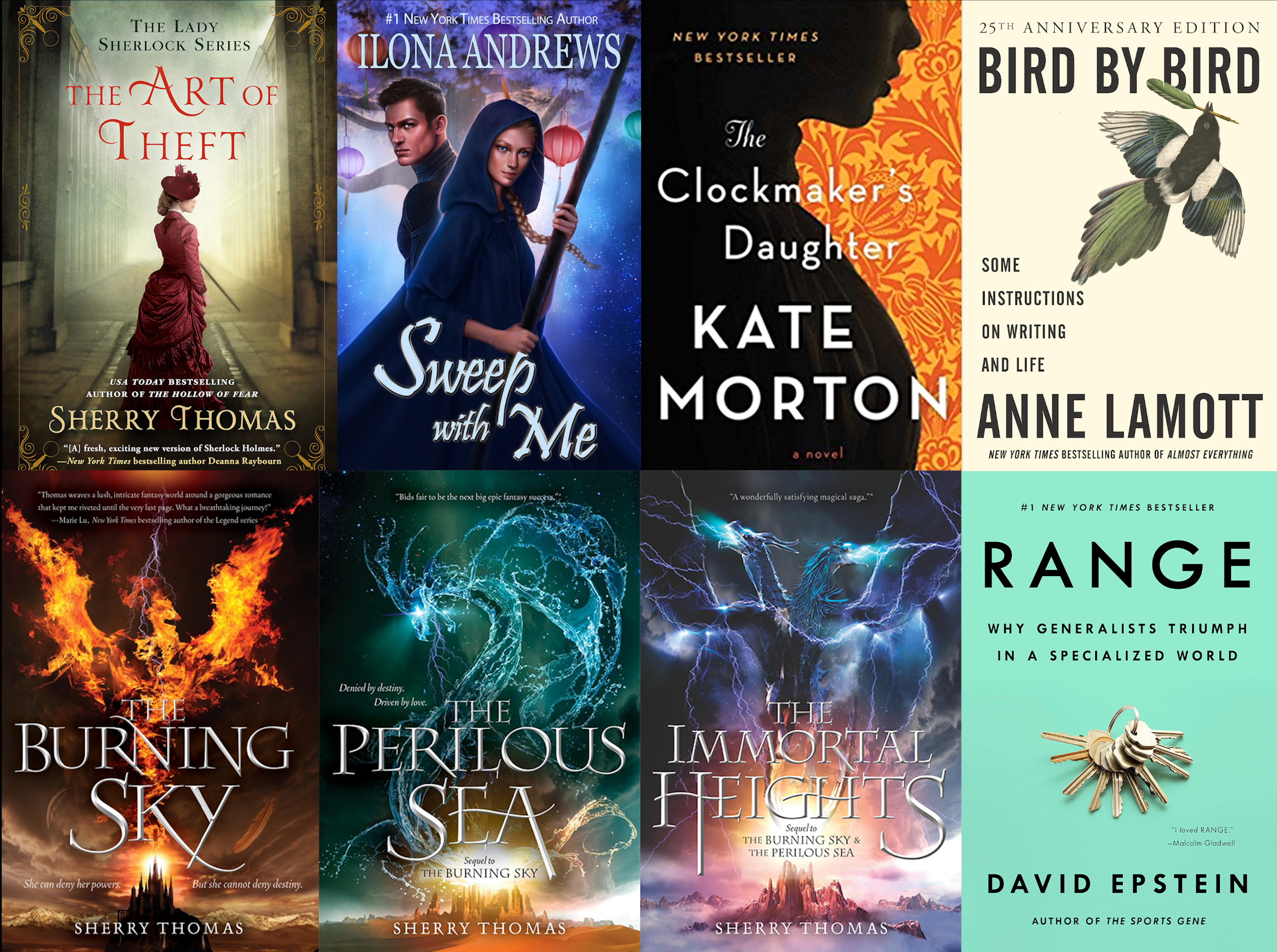
    The Art of Theft by Sherry Thomas

    The Art of Theft by Sherry Thomas book cover

    This is the fourth installment of Thomas’ Lady Sherlock series. I wrote about the previous three back in October, and finally got my copy from the library in December. That’s the Problem With Popular Books. This book continues the lives of the characters, as expected, and is engaging, etc. etc. Mostly this made my list of Books To Talk About because I want to commend the author (or editor) who has cracked down on the use of the phrase “which happened to be”. I have Sherry Thomas herself to thank for the discovery of my hate for that phrase, when used incorrectly. It is acceptable when the feature being described is something coincidental or ironic, not when you just want more words to say that something is. When used purely to flower up your language, I picture you going around perpetually surprised by your environs, eyebrows frozen up at your hairline.

    The Burning Sky Trilogy, by Sherry Thomas

    The Burning Sky by Sherry Thomas book cover

    Now we get straight fantasy from Thomas, having previously explored her takes on historical and modern fiction. This is a trilogy in the book-in-three-parts sense, with only sub-conclusions to the first two books. In other words, ya gotta read them all. Thankfully, they are highly readable and engaging (I might need to find a new word for that soon)—once you get into it, that is. The beginning of the first book is the most difficult part to get through: it is exposition-heavy to the point that I almost gave up reading halfway through the second chapter. My persistence was ultimately rewarded, though. My only other big complaint was the footnotes. Throughout the series, she uses footnotes to add more detail and explanations. While I like these additions and the world-building they bring, I don’t like the format. Footnotes in this context felt very clunky. I would have preferred something like chapter openers, even if that meant sacrificing some of the information.

    Bird By Bird by Anne Lamott book cover February Reading

    Bird By Bird by Anne Lamott

    While this is ostensibly a book on writing (alright yes the tag says “and life”), Lamott has stuffed it full of her observations on life, and her advice for living. Even the parts on writing and the writing process are easily and directly applicable to non-writing aspects of live. Best of all, she writes with a humorous and what I can only describe as real voice that at times had me legit laughing out loud. Highly recommend.

    Sweep With Me by Ilona Andrews

    Sweep With Me by Ilona Andrews book cover February Reading

    Full disclosure before I get into this one: I absolutely love everything I have read by Ilona Andrews. Their settings and characters are just everything I want in life, and I don’t care if you disagree with me. “Sweep With Me” is the fifth book in their Innkeeper Chronicles series, which I believe starts its life as blog installments before moving to book form. This one concludes some arcs from the third and fourth books, but still leaves open some big questions that have been lurking in the background throughout the series. It felt a little short to me, but I do always want more from them so that might be it. I’m frankly too lazy to check actual lengths, since I only have Kindle editions. I highly recommend checking out the first book, Clean Sweep (PUNS), if you’re at all interested in alternate-Earth fantasy with aliens.

    The Clockmaker’s Daughter by Kate Morton

    Clockmaker's Daughter by Kate Morton book cover February Reading

    We’ve finally made it to actual February reading! Here we have a mystery woven through the centuries (ok, a century and a half). This is a beautifully written book with a rich cast of characters connected through time and place. The reveals are well paced to maintain interest, in that sweet spot of progressing quickly while still giving you time to breathe. The exception in my mind is the end, which did feel a little rushed. Or I might have been reading it too quickly. The world may never know.

    Range by David Epstein

    Range by David Epstein book cover  February Reading

    This book is an examination of the modern love of specialization, and why that is stifling innovation. Also, why you shouldn’t feel left behind if other people are “ahead” of you: different paths lead to different specialties and, crucially, different collections of knowledge. Epstein weaves a narrative line through anecdotes and biographies, exploring the differences between breadth and depth; the latter is valuable, but the former is required for making true progress, by connecting disparate subjects.

    February Reading Roundup Review

    I’ve left out some December/ January/ February reading in the interest of, well, interest. Check out my October reads for some insight into that. Right now I’m really enjoying the books on writing, because – shocker – writers make really good authors, and they have some good insight on life. I also have a growing pile of physical books that I need to read, that I keep pushing down the list as library books come off hold. [Ok side note I’ve spent a long time now looking at that last phrase, and I can’t tell if that’s proper English. Do book come off hold? Come up for checkout? Get off the hold list? Someone please help me I don’t know what to say.] SO, if you have sent/loaned/watched me buy a book recently and it hasn’t been featured yet, it’s assuredly not because it didn’t make the cut. I’m just not to it yet.


    Like this? Check out some other recent posts!

  • November Reading (Writing) Roundup and Where I’ve Been

    WHERE IN THE WORLD IS CARMEN— EMORY ROSENOW? Well, I’m still in my awesome reading chair and lost in a book! I’ve just spent the last month lost in a novel of my own writing for a change. (Oh my!) Don’t worry, I still have a couple of book recommendations for you people from things I read in November. There’s just fewer this month – partly because I’ve been waiting for an approximate AGE on SEVERAL books from the library (READ FASTER, PEOPLE).

    WHERE— No wait we just established that. WHAT?

    So. I decided to participate in National Novel Writing Month this year, after talking about doing it for the last I DON’T KNOW six years? But this year I completed it. (Note that this is not the same as completing the novel.) The challenge, for all the cool kids out there who aren’t horrible nerds like me, is to write 50,000 words of a novel during the month of November, or about 1667 words per day. I have accomplished that (please clap), and right now I’m sitting on I don’t know what percentage of a very rough draft, not ready for human consumption yet. So unless you’re a literarily-inclined cat (in which case I have questions) there’s nothing for you to read yet. Patience.

    National Novel Writing Month winner banner November reading
    THAT’S RIGHT, I’M A WINNER

    I will say, I have discovered this neat trick for writing a novel. It’s not a novel idea or anything, but I think it could be useful for you, if you’re interesting in getting into any kind of writing. If you want to write something, you write, and then you don’t stop writing. (Just like flying is falling but missing the Earth.) Anyway, now onto the reading part of the November Reading Writing!

    Book Recommendations

    Now the really good stuff that you’ve actually been waiting for! (And if that’s the case I’m really sorry, but you have hyped this up too much. Not me. You.)

    Between You and Me: Confessions of a Comma Queen by Mary Norris

    This is my #1 reading recommendation from November. It’s part grammar, part memoire, part history, and entirely delightful. I legitimately was laughing out loud frequently while reading this. Mary Norris worked in the editing stews of the New Yorker as a copy editor for twenty-four years, and draws heavily on those experiences to write her version of How English Works. She uses a lovely writing style (shocking) and interesting anecdotes to explore different facets of grammar, spelling, and common usage. Good luck predicting what she’s going to write about next, too. Huge thanks to Appletree Books for including this in their November local author reading recommendations (Mary Norris is a Cleveland native). Now I know even more useless trivia with which I can amaze (not annoy) my friends!

    Ten Things I Love About You by Julia Quinn

    Yes, more Julia Quinn. I’m going to read all her stuff. They’re better romances than most of the ones you see. Anyway, none of that’s the point. The point is that, in this book, they wait for the tea to steep. That’s right: the characters take the time to steep their tea properly. None of this nonsense of dropping a teabag into water and going HEY LOOK IT’S TEA, or, even worse, using a gottdam Keurig and magically having tea (Ilona Andrews I love you so much but I am looking at you so hard right now). Tea takes a hot second. Not like an age, but LORDY PEOPLE let your poor characters drink some proper brew, you’re putting them through enough without making them drink leaf water.

    Make Space by Regina Wong

    This is a book about minimalism. I was like hey cool, sounds interesting, I’m interested in leaning more that direction in my life, I’ll see what Regina GeorgeWong has to say. Oh. My. Goodness. This was the most repetitive book I think I’ve ever read. You would think that a book on minimalism would, I don’t know, get to the point? Not repeat itself multiple times? WongWrong. There are good points to it but HEAVENS TO BETSY does it take a DAY to get to them. My assessment: not worth your time. Don’t make space in your reading schedule for this one.

    November Reading Writing Others

    The others are more Julia Quinn, but honestly there’s like only so much you can write about them. Rather, only so much I can write about them. An Offer From a Gentleman is a Cinderella retelling. The Secret Diaries of Miranda Cheever is what happens when you never move on from your childhood crush. What Happens in London is enemies to lovers trope… no, actually on second thought there’s a little more I can say about that one: it takes place entirely in London, and there are Russians.

    I’m also considering adding more than books to my recommendations, because I think that my opinions should be valuable to you. If you want this from me, please go yell out your front door so I know. If you missed it, be sure to check out my October Reading Roundup for even more romance novels (because nothing says Spooktober like Regency-era lovers). Otherwise, this is my November Reading Writing Roundup out.

  • October Reading Roundup

    Posts are going to be a little thinner on the ground for a moment, while I’m doing THINGS. LOTS OF THINGS. EXCITING THINGS. Yay! And no I’m not going to write about them just yet. Sorry. Anyway, for now here’s some of my October reading (it’s a little romance-heavy, just so you’re forewarned), from the good to the don’t waste your time.

    October Reading: book covers!
    October Reading In Color

    The Bookish Life of Nina Hill by Abbi Waxman

    A thoroughly entertaining, light-hearted read. The characters are vivid, varied, and charming, and the scenes are set clearly. However, I felt that the pacing was just a little off. Not terrible, but it felt a bit like it was over before it started, or rather the big conflict happened without me noticing it. That could of course be on me. Jeni’s Ice Cream makes an exciting cameo, for my fellow Columbus-ites (ugh).

    A Study in Scarlet Women by Sherry Thomas

    Sherlock Holmes but he’s a woman. Also so is like everyone else. Glorious. The premise is lovely, the characters are very good, and it takes you straight to late Victorian London without passing go. And while I had some issues following dialogue (DIALOGUE TAGS ARE GREAT. USE DIALOGUE TAGS. Thomas clearly needs to read some Thursday Next.) and there were some whiplash perspective changes, the writing was overall solid. This is the first in her Lady Sherlock series, and it does a great job of setting up future tales of the great detective. The violin playing seems to be absent, though.

    The One in My Heart by Sherry Thomas

    When I went to check out the next book in the Lady Sherlock series, there was a WAIT LIST so I decided to try another book by the same author. According to the blurb description, this is her first foray into modern romance; her modern society looks somewhat different from mine, but I guess I also didn’t grow up on Park Ave so what do I know.

    The characters eventually gelled, but I spent the first half of this STRUGGLING to understand anyone’s motivations and also just what was happening. Thomas likes to keep the reader in suspense, which is a great technique, but we need some basic info. Literally every character was keeping significant secrets for most of the book, so there really wasn’t anyone to side with. Dialogue tags were again an issue (it’s pretty cool to read a scene and then get to the end and realize you had the characters flipped. Also odd that that kept working…). This book does deal with some serious mental health issues in what I thought was a sensitive and caring way, and the main character is good at condemning statutory rape, so that’s pretty cool. There is also just a ton of sex in this book. Like, a few scenes short of being straight erotica. (I exaggerate slightly.) Just so you know.

    A Conspiracy in Belgravia by Sherry Thomas

    BOOK TWO, WOO! Characters in this Lady Sherlock sequel seem to have really stabilized, and the dialogue tags and perspective hops are also improved. The story was engaging and the mystery was well-done, although I personally struggled to keep some characters straight. This is partly a me thing, as I identify characters by the first letter of their names; so if there’s both a Paul and Peter, for instance, I struggle. The pacing was slightly uneven (although never boring), and I thought the denouement delayed the actual explanations just a little bit too long.

    To Catch an Heiress by Julia Quinn

    Talk about wait lists. Julia Quinn, romance author extraordinaire, has multiple series. Many books. I swear that there’s a wait list on every single one from my library. I’ve been on hold for the second book in her main-ish series for over a month now, and the estimated wait time is still 8 weeks.

    Anyway. This is the first book (of two, so far) in whatever this series is called. The story is entertaining, the characters are strong, and it keeps you engaged the whole time. I’m too lazy to do any actual research, but there were some moments that felt very anachronistic to me; Quinn writes in the Regency period so much though, so maybe she knows better than I. Expert that I am. This is a satisfying romance with great heaps of emotion, so if you’re an emotion junkie like me you’ll love this.

    The Hollow of Fear by Sherry Thomas

    Oh baby it’s book three! Well written mystery that takes its time without feeling stodgy. The reveal was great: not at all predictable, but also not out of the blue. The characters are still strong and ripening like a good cheese. Gouda, probably.

    How to Marry a Marquis by Julia Quinn

    The second book in the Heiress whatever-it’s-called series. A sweet story with a strong female lead and a good supporting cast. There are classic romance tropes (they’re classic for a reason, ok?), but they’re well done. Satisfying as ever.

    The Year of Living Danishly by Helen Russell

    See, I don’t just read romances! Although I’m sure you could argue that this is a romance too: this will make you fall in love with The Danish Way. This is a highly entertaining account of the author’s year abroad in Denmark, and her attempts to understand hygge and to integrate (or not) into the Danish culture. Notably, what is it that makes Denmark the Happiest Country in the World? This book is full of sharp observations, good tips, realistic takes, and witty/hilarious dialogues. I highly recommend this book.

    October Reading Roundup Review

    Helen Russell has taught me to end chapters with bullet point summaries. Therefore: What do I think about my October reading?

    • Romances are great hits of emotion.
    • Dialogue tags are important.
    • I get stuck on authors.
    • It’s now November, and I need more hygge in my life.